Africa is often called the cradle of humanity — yet the story most of us were taught skips straight from that ancient beginning to the horrors of enslavement, as if nothing of consequence happened in between. Volume 1 of The History of Black History opens by correcting that erasure. Between the 13th and 16th centuries, three great powers — the empires of Mali, Songhai, and Great Zimbabwe — built legacies of innovation, art, culture, and trade that rivaled anything in the medieval world.
The rise of Mali
Mali's ascent can be traced to the older Kingdom of Ghana, which controlled the lucrative trans-Saharan trade routes. In the early 13th century, a leader named Sundiata Keita conquered Ghana and expanded his territory dramatically. Celebrated in oral tradition as the founder of the Mali Empire, Sundiata's reign marked the beginning of a golden age — one built on the twin currencies that made West Africa rich: gold and salt.
Mali sat astride the routes that carried these goods across the desert to North Africa and beyond. Whoever controlled the roads controlled the wealth — and for two centuries, that was Mali.
Mansa Musa: the richest man who ever lived
The most illustrious figure in Mali's history is Mansa Musa, who ruled in the early 1300s. His wealth was so vast that historians have called him the richest individual in all of human history. But it was not his fortune alone that made him legendary — it was what he did with it.
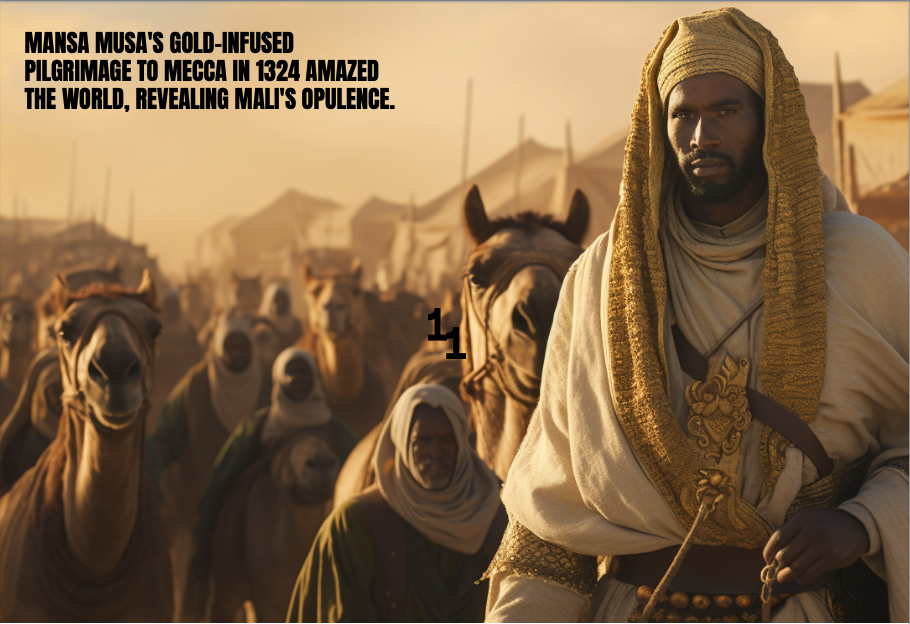
Mansa Musa's caravan was said to include thousands of attendants, and so much gold that his generosity reshaped economies along his route.
In 1324, Mansa Musa set out on a pilgrimage to Mecca. His procession was so enormous — and his distribution of gold so lavish — that his passage through Egypt reportedly disrupted the value of gold in Cairo for years afterward. The pilgrimage did more than display Mali's riches; it announced the empire to the wider world and deepened the spread of Islam across West Africa.
Timbuktu: a city of scholars
Perhaps Mali's greatest treasure was not gold but knowledge. The city of Timbuktu, on the Niger River, grew into a vital trading hub and, more remarkably, a center of learning. Its universities and libraries drew scholars and students from across Africa and the Islamic world. Manuscripts on astronomy, medicine, mathematics, and law filled its collections — proof, written in ink, that Africa's contribution to human civilization is far older and deeper than most textbooks admit.
The architectural marvels of the empire — the Great Mosque of Djenné and the mosques of Timbuktu — still stand as monuments to that age.
Songhai: the empire of the sun
As Mali declined in the 15th century under internal strife and outside pressure, a new power rose along the same great river. The Songhai Empire began as a small kingdom centered on the city of Gao. Under Sonni Ali in the late 1400s, Songhai expanded aggressively, conquering Timbuktu and Djenné and absorbing the trade that had made Mali great.
His successor, Askia Muhammad, took the throne in 1493 and gave the empire what conquest alone could not: organization. Askia built a centralized administration, promoted Islam, and made his own pilgrimage to Mecca, cementing Songhai's status as a major center of Islamic culture and scholarship. At its height, Songhai was one of the largest empires in African history.
Great Zimbabwe: the stone city of the south
Far to the southeast, another civilization tells a different chapter of the same truth. Great Zimbabwe — a city of massive stone walls built without mortar — was the heart of a trading state that connected the African interior to the Indian Ocean coast. Its ruins, some walls rising over thirty feet, still astonish visitors and stand as one of the most significant archaeological sites on the continent.
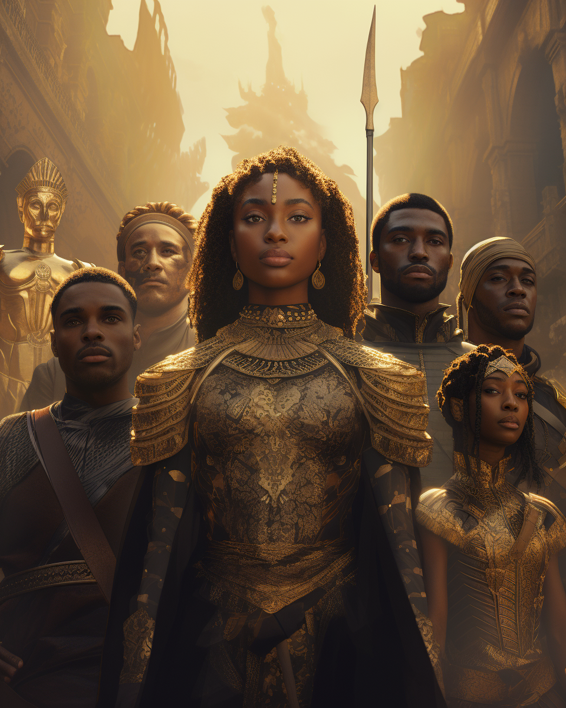
See this history — beautifully illustrated.
Mansa Musa, Timbuktu, Songhai and more come to life in the full illustrated volume of The History of Black History, Vol. 1.
Get it on Amazon →
Why this history matters
These empires matter because they rewrite the starting point of the story. The people who would later be stolen and enslaved did not come from a blank continent — they came from societies with kings and scholars, universities and cathedrals of stone, gold economies and global trade networks. Understanding that is the first step toward understanding everything that follows: the scale of what was taken, and the depth of what endured.
That is exactly where The History of Black History begins — and why it begins there.